
Subtraction within 20 on a Number Line: Parent Guide
Subtraction within 20 on a Number Line: Parent Guide
This post accompanies our YouTube video from 2026-08-13: https://www.youtube.com/@britishlearningcentre4077/search?query=Subtraction%20on%20a%20Number%20Line
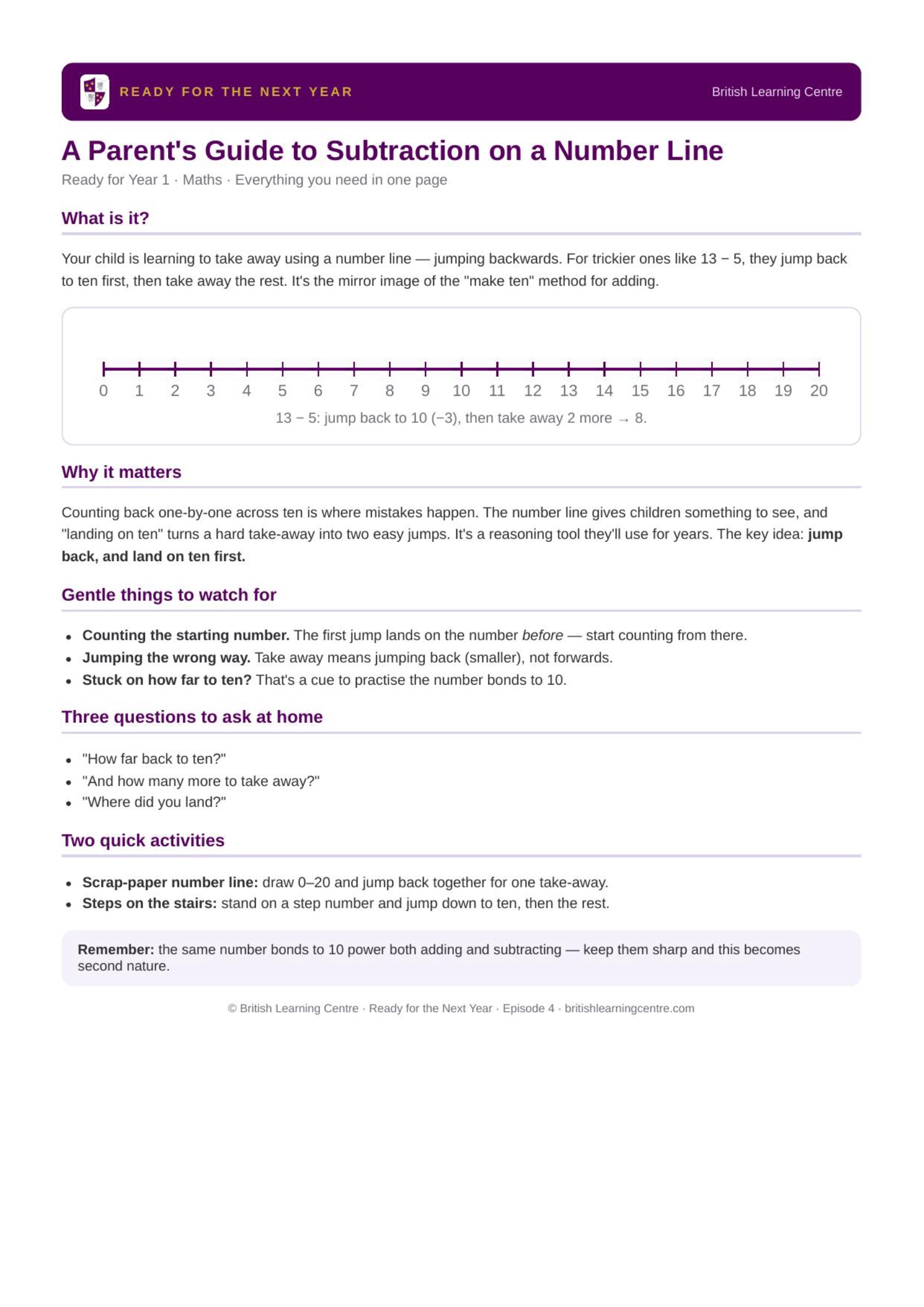
Subtraction within 20 becomes clearer when children can see it. A number line lets them jump backwards, and for trickier calculations such as 13 − 5 they can land on ten first, then take away the rest. It is the mirror of bridging ten for addition.
Why the number line helps
Counting back one by one across ten is where mistakes gather. The number line gives something to see, and landing on ten turns a hard take-away into two easier jumps. British Year 1 teaching uses this as a reasoning tool, not only a counting track.
How landing on ten works
For 13 − 5, jump back from 13 to 10 (that is 3), then take away the remaining 2, landing on 8. Ask: How far back to ten? How many more to take away? Where did you land? The same number bonds to 10 that powered addition now power subtraction.
Watch for these gentle pitfalls
Children sometimes count the starting number as the first jump. The first jump should land on the number before. Others jump forwards when they meant to take away. Take away means jumping back to a smaller number. If the distance to ten is unclear, revisit bonds to 10.
Watch the video
- Primary video: https://www.youtube.com/@britishlearningcentre4077/search?query=Subtraction%20on%20a%20Number%20Line
- Subtraction within 20 using number lines and making ten first.
- Pause on a worked jump and redraw the same jumps on scrap paper together.
- Compare with the bridging-ten addition video so both directions feel connected.
Key steps from the lesson
- Start at the larger number on the number line.
- Jump back; for sums that cross ten, land on ten first.
- Complete the leftover jump.
- Check the landing number and say the full calculation.
Practise at home
- Draw a scrap-paper number line from 0 to 20 and jump back together for one take-away at a time.
- Use stairs if you have them: stand on a step number, jump down to ten, then finish the rest.
- Ask: How far back to ten? How many more to take away? Where did you land?
- Keep number bonds to 10 sharp; they drive both adding and subtracting across ten.
- Prefer one clear example done well over a long list of rushed sums.
- Celebrate careful jumps more than speed.
Soft next step with British Learning Centre
When number-line jumps and bonds need patient coaching, online British-curriculum Maths support can help. Visit britishlearningcentre.com to explore placement, book a free trial, or ask about Year 1 ready pathways with British Learning Centre.
FAQ
Is a printed number line essential?
No. A drawn line on paper is enough. Consistency of jumps matters more than a perfect template.
My child subtracts by counting objects instead. Is that wrong?
Concrete objects are a strong start. The number line becomes useful when mental counting back becomes unreliable across ten.
How does this link to part-whole models?
Part-whole shows the relationship; the number line shows the journey. Many children benefit from both.
How often should we practise?
Short daily bursts of a few calculations beat occasional long worksheets.
Comments
Loading comments…