
Free Spelling Games for Home Practice: How to Help Your Child Learn This Week’s Spellings
A couple of weeks ago, outside Garden International School Rayong, I recorded a short video for a parent worried about his child’s spelling. My answer was simple: what we teach in class only sticks if the words are looked at again during the week. A rule taught on a Wednesday and not seen again until the following Wednesday is very hard to remember for the test.
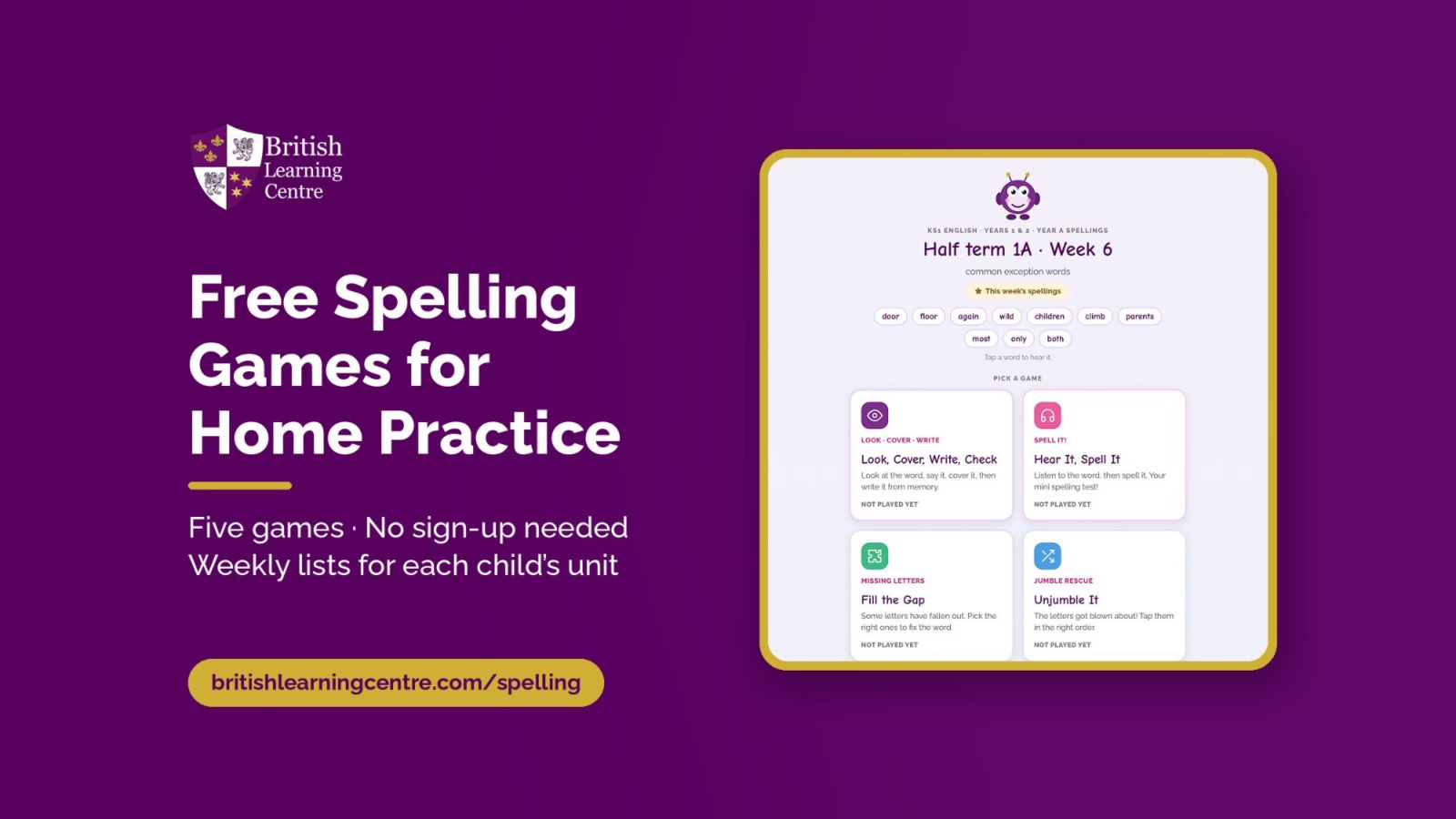
To make that home practice easier, we have added free spelling games to our website at britishlearningcentre.com/spelling. They use the same weekly lists we teach in class, so your child practises the words they will be tested on. Here is how to use them, with a routine that fits into a busy week.
What is on the spelling page
Choose your child’s class and the page shows the weekly spelling lists for that class, grouped by half term. Each week shows its start date, the spelling rule being taught and the words themselves. You can tap any word to hear it read aloud.
There are lists for KS1, Lower KS2 and Upper KS2 English, and for each level of our Early English classes, from phonics words up to A2+ spellings.
Once you have opened a week, your child can pick from five games:
- Look, Cover, Write, Check. Look at the word, say it, cover it, then write it from memory. If a letter is wrong, it is shown in red so your child can see exactly where the mistake was.
- Hear It, Spell It. The word is read aloud and your child spells it, a little like a mini spelling test. There is a button to hear the word again slowly.
- Fill the Gap. Some letters are missing and your child picks the right ones to complete the word.
- Unjumble It. The letters are mixed up and your child taps them in the right order.
- Word Search. The week’s words are hidden in a grid, ready to be found.
At the end of each game your child earns up to three stars and a sticker for their sticker jar, and sees a list of words to practise. The games are free, with nothing to sign up for.
How to use it at home, step by step
- Open the page. Go to the spelling games page, or choose Spelling games from the website menu.
- Choose your child’s class. If you are not sure which list your child is on, ask their teacher.
- Pick the week your teacher set. The current week is marked as this week. There is also a shortcut to last week’s words, which is useful if the test is on the words from the previous lesson.
- Listen to the words first. Tap each word to hear it and let your child say it back to you. Make sure the sound is turned up.
- Choose a game. Start with Look, Cover, Write, Check, then move on to the others as the week goes on.
- Look at the words to practise. When a game finishes, note any words that caused trouble and start with those next time.
A simple weekly routine
Ten minutes a day will do far more than an hour the night before the test. This is the routine I would suggest, counting from your child’s lesson day:
- Day 1 (lesson day): Listen to the words together, then play Look, Cover, Write, Check.
- Day 2: Play Fill the Gap.
- Day 3: Play Unjumble It, then do a Word Search as a lighter session.
- Day 4: Try Hear It, Spell It as a practice test. Write down the words to practise.
- Day 5: Practise those words on paper with Look, Cover, Write, Check at the dining table.
- Day 6: Play Hear It, Spell It again and see how many stars your child can earn.
- Day 7: Rest from the games and read together instead.
If your child is keen, open All weeks and look ahead at the next list before the lesson.
Reading still matters
Practising the spelling words is important, but so is reading every day. Children who read regularly see words spelt correctly again and again, which helps far beyond the weekly list.
I would also ask parents not to become too worried about spelling. We never want a child to stop using ambitious vocabulary because they are afraid of getting a word wrong. If your child spells a bold new word slightly wrong, praise the choice first and correct the spelling afterwards.
I talk through these tips in the earlier video below.
Would you like to know where your child is?
If your child is not yet learning with us, or you would like to know how their English compares with British National Curriculum expectations, you are welcome to take a free assessment or book a free trial lesson. Our teachers will be happy to suggest the right class.
Frequently asked questions
How long should my child practise spellings each day?
About ten minutes a day is enough for most children. Little and often works better than one long session.
Which list should my child use?
Choose your child’s class on the spelling games page, then pick the week their teacher set. If you are unsure, ask the teacher, who can send you a link to the right list.
Does my child need an account to play?
No. The games are free and open to anyone. Stars and stickers are saved in the browser, so use the same device each time.
What if my child keeps getting the same word wrong?
Go back to Look, Cover, Write, Check for that word and look closely at the letters shown in red. Saying it slowly, sound by sound, often helps. If spelling remains a real struggle despite regular practice, please speak to your child’s teacher.
Comments
Loading comments…