
Free Bilingual Booklets for British Curriculum Pupils
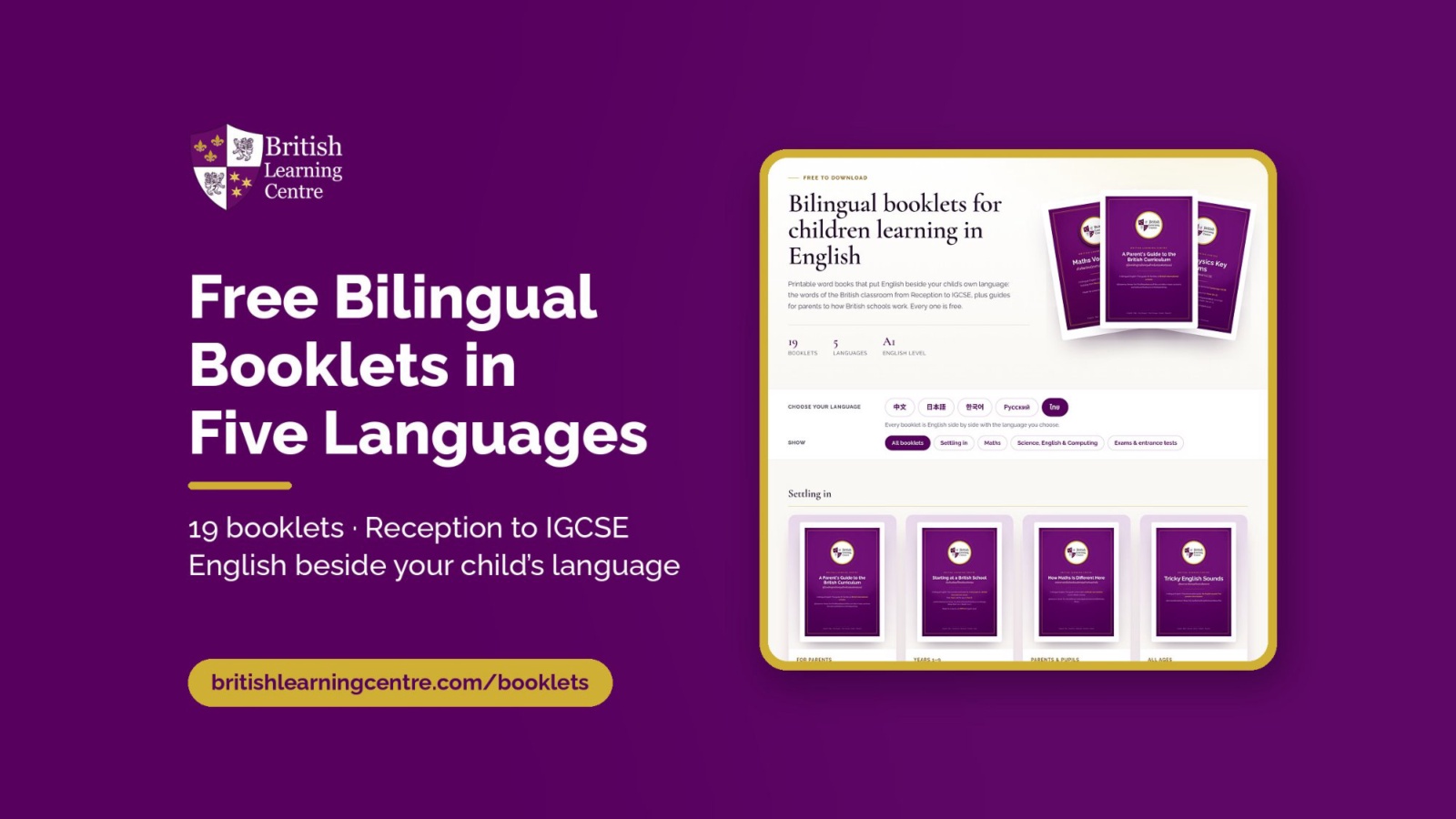
For many children in Thailand, a British international school means learning in a language that is not spoken at home. Words such as "denominator", "photosynthesis" or "evaluate" can stand between a capable child and the lesson in front of them. To help with exactly that, British Learning Centre has published a free library of bilingual booklets, available now at britishlearningcentre.com/booklets.
What the booklets are
The collection contains 19 printable booklets. Each one sets English side by side with a second language of your choice: Thai, Chinese, Japanese, Korean or Russian. Together they cover the words of the British classroom from Reception to IGCSE, along with guides that explain to parents how British schools work. Every booklet is free, and each one opens or downloads as a PDF straight from the page.
The word books are written for a learner at CEFR A1 English level, so a child can start using them in their very first week in an English-speaking class.
Every word, four ways
The word books are designed to be read across a row, from left to right. Each word is shown in four ways:
- The English word your child will hear and read in lessons.
- A short, easy example sentence that shows the word in use.
- The meaning in your chosen language.
- How to say it: the English pronunciation, spelled out in your own script.
What is inside the collection
The booklets are arranged in four groups.
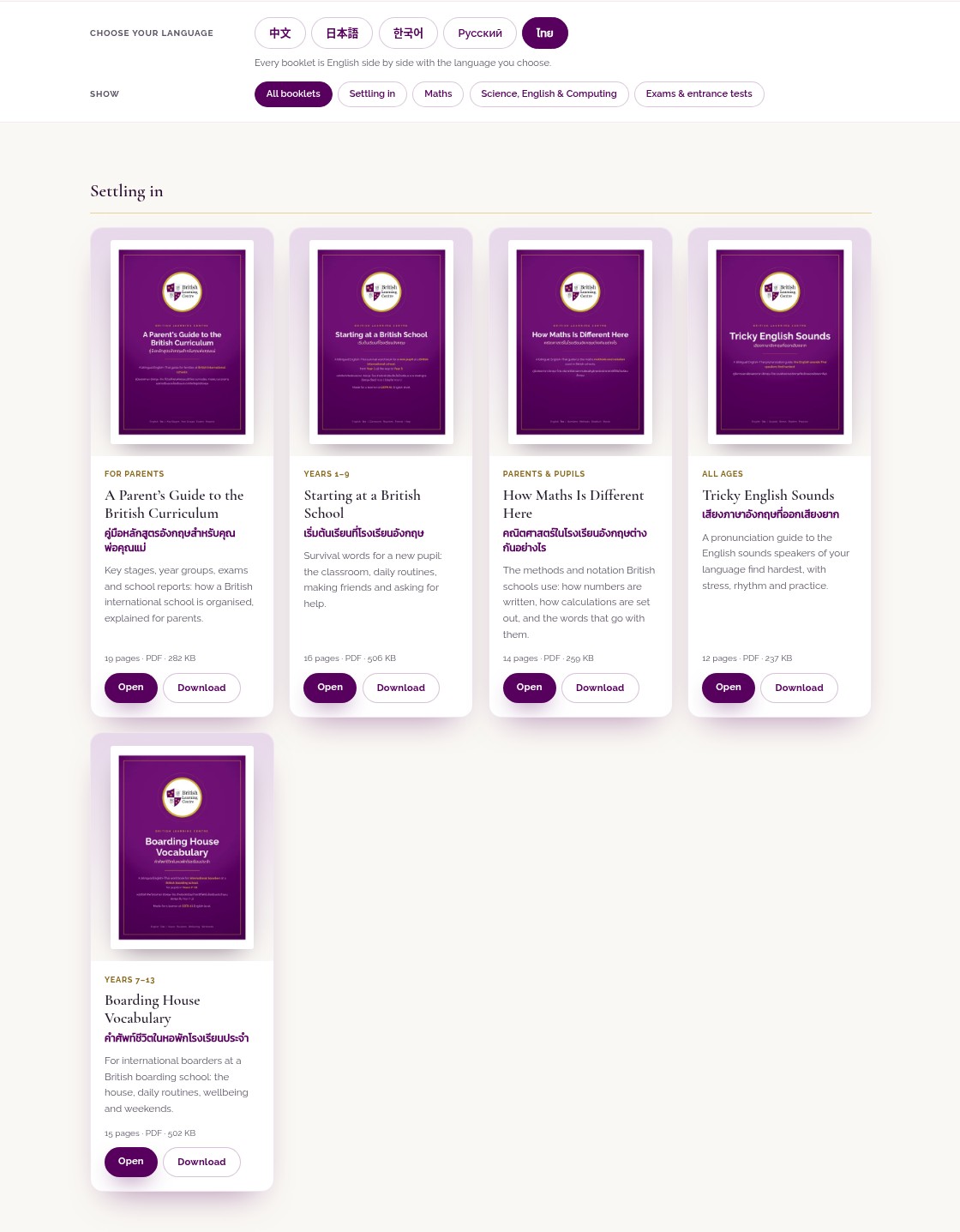
Settling in. A Parent's Guide to the British Curriculum explains key stages, year groups, exams and school reports, including a section on reading a school report and on supporting learning at home. Starting at a British School (Years 1 to 9) gives a new pupil survival words for the classroom, daily routines, making friends and asking for help. How Maths Is Different Here sets out the methods and notation British schools use, Tricky English Sounds is a pronunciation guide for all ages, and Boarding House Vocabulary (Years 7 to 13) supports international boarders.
Maths. Maths Vocabulary builds year by year from Reception to Year 9 across number, algebra, shape and data. Alongside it are the Maths Word Problem Decoder, which shows which key words signal adding, subtracting, multiplying or dividing; Maths Word Mats, with one desk mat per key stage; double-sided Maths Flashcards from Reception to Key Stage 3; and an A3 Maths Symbols Poster naming every symbol from + and = to √ and π in both languages.
Science, English and Computing. Science Vocabulary (Reception to Year 9) covers living things, materials, forces, and Earth and space. English Grammar & Literacy Terms (Years 1 to 9) explains the grammar, punctuation, reading and writing terms used in English lessons, and Computing & ICT Vocabulary runs from Year 3 through to IGCSE Computer Science.
Exams and entrance tests. Entrance Test Vocabulary covers the language of 11+, CAT4 and British international school entrance tests. Exam Command Words explains what each command word in a Cambridge Checkpoint or IGCSE question is asking a student to do. Finally, four IGCSE key terms booklets cover Mathematics, Biology, Chemistry and Physics for Years 10 and 11.
Who the booklets suit
The collection is designed for children who are learning in English while another language is spoken at home. That includes Thai children moving into British international schools, families relocating to Thailand from China, Japan, Korea or Russia, and pupils who would benefit from a firmer grip on subject vocabulary.
Parents are very much part of the audience too. If you did not go to school in the British system yourself, terms such as "Key Stage 2", "working at the expected standard" or "INSET day" can be puzzling. The parents' guide explains them in your own language, so you can read school reports and attend parents' evenings with confidence.
How the booklets support learning at home
Subject vocabulary is often the hidden barrier in British curriculum lessons. A child may understand the mathematics perfectly well, yet be held back by the wording of the question. The maths booklet itself suggests learning a little each day, one group of words at a time, saying each word aloud and ticking it off once it is known.
You might print the word mat for your child's desk, put the symbols poster on the wall, or work through a few flashcards before school. Older students preparing for Checkpoint or IGCSE can use the command words and key terms booklets to make sure they understand exactly what each question requires.
How to get your free booklets
- Visit britishlearningcentre.com/booklets.
- Choose your language: Thai, Chinese, Japanese, Korean or Russian.
- Browse all booklets, or filter by group.
- Select Open to view a booklet, or Download to save the PDF and print it at home.
There is no charge for any of the booklets.
Taking the next step
Some families will also want to know where their child's English stands today. British Learning Centre offers free online assessments, which give a CEFR level in about half an hour. From there, our certified native-speaking teachers can support your child through the British National Curriculum in Pattaya, at Lasalle's Avenue in Bangkok, or online.
Download your free bilingual booklets, or take a free assessment to see where your child's English is today.
Comments
Loading comments…